HOME / INSIGHTS / chef collab dinner marketing
The Pop-Up Playbook: Why Chef Collaborations Are NYC’s Highest-ROI Content Events Right Now
BY ADMIN · UPDATED SEP 2026
QUICK ANSWER
Experiential dining isn’t a niche trend anymore. It’s become one of the most reliable ways to generate both bookings and content in a single event, and chef collaborations specifically have turned into one of the highest-return formats available to a restaurant willing to put one together.
Experiential dining isn’t a niche trend anymore. It’s become one of the most reliable ways to generate both bookings and content in a single event, and chef collaborations specifically have turned into one of the highest-return formats available to a restaurant willing to put one together.
What’s actually driving this
OpenTable’s 2026 Dining Trends Report found that experiential dining, chef’s tables, tasting menus, themed nights, and collaborations rose 46 percent year over year, with restaurants offering roughly a third more pop-ups and collaborations than the year before. Nearly half of Americans surveyed said they’re more likely to book a restaurant specifically because it’s hosting a pop-up, collaboration, or special experience.
This isn’t just a diner preference showing up in a survey. Restaurant groups running these events are seeing it play out directly. Momofuku’s marketing team has described a real surge in interest around collaboration-specific dinners after launching a themed noodle night series pairing their own kitchen with outside chefs, with each installment selling out. That’s not a hypothetical trend. It’s a working format other NYC restaurants can adapt at a much smaller scale.
Why a pop-up outperforms a normal promotional push
A one-night-only collaboration creates something a standard menu promotion simply can’t: genuine scarcity paired with a real story. A guest booking a table for a one-time guest chef takeover isn’t just deciding where to eat that night. They’re deciding whether to be part of something that won’t happen again, which is a fundamentally more shareable, more content-friendly decision than picking a restaurant for a normal Tuesday dinner.
That scarcity also solves a practical marketing problem. A pop-up gives you a hard deadline and a specific hook to build content around, which is often the missing ingredient in restaurants that struggle to post anything beyond another plated dish photo.
Planning a collaboration that actually sells out
Pick a collaborator whose audience genuinely overlaps with yours, not just whoever’s available. A guest chef with a following that has no real connection to your restaurant’s existing guests generates less genuine demand than one whose audience is a natural, if not identical, match for the people who already come to you.
Give it a real concept, not just “guest chef night.” A one-night takeover built around a specific theme, a regional cuisine, a particular ingredient, a shared culinary philosophy between you and your collaborator, gives guests and press something more specific to talk about than a generic collaboration.
Build in genuine scarcity, and be honest about it. A single seating, a strictly limited number of covers, or a short run of just two or three nights creates the real urgency that drives bookings. A “pop-up” that’s actually available every week for a month doesn’t carry the same weight.
Start promotion earlier than you would for a normal special. Because the appeal depends on scarcity, guests need enough lead time to actually plan around it. A collaboration announced the same week it happens loses much of its drawing power compared to one with several weeks of anticipation building beforehand.
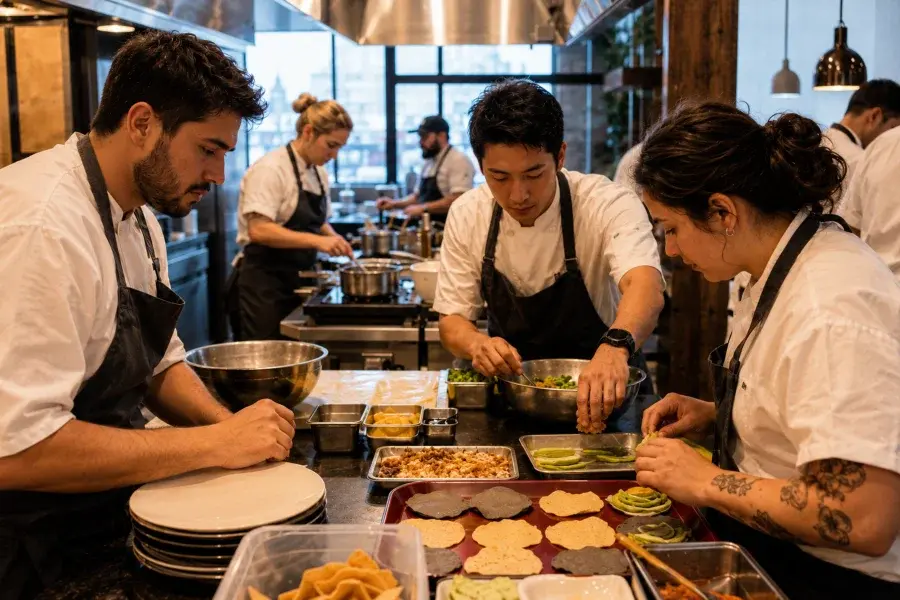
Document the process, not just the final event. Behind-the-scenes content leading up to the collaboration, planning the menu, prepping ingredients unusual for your kitchen, the two chefs working together, often generates more engagement than the polished final plated shots, since it makes the audience feel like part of the buildup.
Keep this distinct from your existing experiential content
This is a different format from the Chef’s Counter strategy already covered on the blog, which is about a permanent seating and service format built around ongoing guest-chef interaction. A pop-up collaboration is a temporary, marketable event with a hard start and end date. Both can coexist in the same restaurant’s strategy, but they solve different problems: one is a standing feature of your dining room, the other is a limited-time content and booking event.
It’s also worth pairing with other experiential formats you may already run. Sommelier-led content and wine programming can be a natural collaboration partner in its own right; a guest sommelier or winemaker dinner follows the exact same scarcity-and-story logic as a chef collaboration.
Where this fits into your fall calendar
Pop-ups and collaborations work well as a recurring feature in your broader content and promotion calendar rather than a one-off experiment. A restaurant that runs one well-executed collaboration a quarter builds a reputation for doing something worth watching for, which compounds over time in a way a single event never could on its own.
FREQUENTLY ASKED QUESTIONS
OpenTable’s 2026 data found nearly half of Americans surveyed said they’re more likely to book a restaurant specifically because it’s hosting a pop-up, collaboration, or special experience, alongside a 46 percent year-over-year rise in experiential dining generally.
Genuine scarcity paired with a real story. A one-time collaboration gives guests a reason to act now rather than “maybe sometime,” and gives you a natural, specific hook for content that a standard promotion doesn’t have.
Earlier than a normal special, since the appeal depends on guests having enough lead time to plan around a limited, non-repeating event. Announcing it the same week it happens loses much of the anticipation that drives bookings.
A short run, generally a single seating up to two or three nights, tends to preserve the sense of genuine scarcity that makes the format work. A “pop-up” available for a full month starts to feel like a regular menu item instead.
Behind-the-scenes content documenting the planning and buildup, the two chefs working together, unusual ingredients being prepped, often generates more engagement than the final plated photos alone, since it makes the audience feel part of the process.